Outdoor lighting can completely change how a garden, pathway, driveway or building entrance looks after sunset. However, choosing the right fixture involves more than selecting an attractive design.
If you are planning an outdoor lighting project in Pakistan, understanding how to choose outdoor inground lighting can help you avoid poor illumination, installation problems and unnecessary maintenance.
From selecting the correct waterproof rating to comparing wattage and installation depth, this guide explains the important factors homeowners, architects and contractors should consider before purchasing recessed landscape fixtures.
What Is Outdoor Inground Lighting?
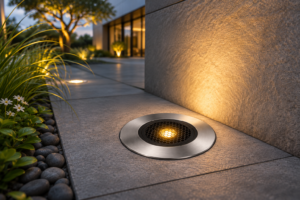
Outdoor inground lighting refers to fixtures installed below or nearly flush with a finished ground surface. Unlike traditional garden lamps mounted on poles or walls, these fittings integrate into paving, concrete and landscaped areas.
They are commonly used to illuminate architectural features, highlight trees, accentuate building facades and guide attention along outdoor spaces.
Their main advantage is a discreet appearance. During the day, the fixture remains relatively unobtrusive. At night, its light can enhance the surrounding landscape.
However, different designs serve different purposes. A narrow-beam uplight may work well for a column or tree, while a pathway needs a carefully planned lighting arrangement to provide useful visibility.
1. Identify Where the Lighting Will Be Installed
The first step is understanding the intended application.
Garden and Landscape Areas
Recessed landscape fixtures can highlight trees, decorative plants, stone features and boundary walls.
For a small residential garden, carefully positioned accent lighting often creates a better result than installing several unnecessarily powerful fittings.
Consider the height of the feature, surrounding plants and the direction of the light before selecting a fixture.
Walkways and Entrance Paths
Pathway lighting should support safe movement while maintaining visual comfort.
Avoid placing strong upward-facing beams directly where pedestrians are likely to look. Shielded optics and appropriate fixture positioning can help reduce uncomfortable glare.
Also consider whether the surface becomes slippery during rain and whether the installed fitting will remain flush with the surrounding pavement.
Driveways and Vehicle Access Areas
Driveway installations require additional attention.
A fitting placed where vehicles may pass must have a manufacturer-confirmed load rating suitable for the expected traffic. Impact resistance alone does not establish how much vehicle weight a fixture can safely support.
Correct installation, drainage and structural support are essential.
Building Facades and Columns
Architectural uplighting can emphasize textures, vertical surfaces and structural details.
The appropriate beam angle depends on the height and width of the feature, the distance from the fixture and the desired lighting effect.
2. Understand Waterproof and Impact Protection
Outdoor recessed fixtures are exposed to environmental conditions that ordinary indoor lighting may not withstand.
Two important specifications are the IP rating and IK rating.
What Does IP67 Mean?
IP67 indicates that a properly assembled enclosure is dust-tight and protected against temporary immersion in water under defined test conditions.
This makes it a useful rating to consider for outdoor recessed installations exposed to rain and moisture.
However, IP67 does not mean a fixture can remain permanently underwater.
For installations where water may collect, drainage and waterproof electrical connections remain essential.
Why Does IK08 Matter?
IK08 is an impact-resistance classification under IEC 62262. It represents resistance to a standardized impact energy of 5 joules.
This helps describe the enclosure’s mechanical protection.
However, IK08 is not the same as a vehicle load rating. If a fixture will be installed in a driveway, ask the supplier for separate confirmation of its drive-over suitability.
3. Compare Wattage Before Choosing a Fixture
Wattage describes electrical power consumption, not the exact amount of visible light produced.
Two fixtures with the same wattage can deliver different brightness levels depending on LED efficiency, optics and design.
For example, the IVORY Walk Way Inground Series includes four power options.
| Model | Power | Fixture Diameter | Height |
|---|---|---|---|
| IVW-09 | 9W | 120mm | 99mm |
| IVW-18 | 18W | 160mm | 113mm |
| IVW-24 | 24W | 160mm | 113mm |
| IVW-36 | 36W | 200mm | 140mm |
These options allow designers to consider different fixture sizes and power requirements.
A smaller model may suit a compact accent-lighting installation, while a higher-power option may be considered where greater output is needed.
Before making a final selection, request the lumen output, beam angle and photometric data for the exact model.
For larger architectural projects, a lighting calculation can help determine the number and placement of fixtures.
4. Select the Right Beam Angle and Glare Control
Beam angle determines how concentrated or widely distributed the light will be.
A narrow beam is generally useful for highlighting tall or slender architectural features.
A wider beam can illuminate broader surfaces, depending on the fixture’s output and installation distance.
Glare control is particularly important in areas where people walk or sit.
Fixtures with recessed light sources, suitable optical lenses or honeycomb glare-control accessories can improve visual comfort when correctly specified and positioned.
The IVORY series uses an optical lens and built-in anti-glare honeycomb design.
The exact beam angle should be confirmed for the selected configuration.
5. Choose Durable Materials for Outdoor Conditions
Outdoor fittings must withstand environmental exposure, including moisture, dust and temperature changes.
Common construction materials include aluminum, stainless steel and tempered glass.
A die-cast aluminum housing can provide structural support and assist with heat dissipation.
Stainless steel covers offer a clean architectural finish, while tempered glass protects the optical components.
For example, the IVORY series features a thickened die-cast aluminum body, a brushed 304 stainless steel cover and 8mm tempered glass.
Material quality matters, but installation conditions also affect long-term performance.
In coastal environments such as Karachi, additional attention should be given to corrosion exposure, cleaning and the suitability of the selected stainless steel grade.
6. Plan Installation Depth and Drainage
One of the most common mistakes in recessed lighting projects is selecting a fixture before checking the available installation space.
Different models require different depths and sleeve dimensions.
For the IVORY series, the manufacturer lists the following PVC installation sleeves.
| Model | Sleeve Dimensions |
|---|---|
| IVW-09 | Ø120 × H120 × Ø115mm |
| IVW-18 | Ø160 × H137 × Ø145mm |
| IVW-24 | Ø160 × H137 × Ø145mm |
| IVW-36 | Ø200 × H170mm |
These are manufacturer-listed dimensions. The final cutout and installation requirements should be checked against the official technical drawing.
Before installation, confirm that the site provides sufficient depth, appropriate drainage and a suitable method for protecting electrical connections.
An experienced electrician should complete the wiring according to the manufacturer’s instructions and applicable electrical requirements.
7. Consider Light Color and Control Options
Lighting color can significantly influence the appearance of an outdoor space.
Warm white is commonly preferred for comfortable residential environments, while neutral white may suit some contemporary architectural applications.
Color-changing systems are useful for selected commercial projects, decorative landscapes and programmable architectural effects.
The IVORY range lists single-color, RGB and RGBW configurations, with DMX512 support for compatible versions.
Before ordering, confirm the available color temperatures, driver requirements and controller compatibility.
8. Consider Local Conditions in Pakistan
Outdoor lighting projects in Pakistan should account for the conditions of the installation site rather than relying only on product appearance.
In Karachi, coastal exposure and corrosion resistance may be important considerations.
In Lahore and Multan, heat, dust and the surrounding installation environment should be assessed.
In Islamabad and Sialkot, rainwater management and seasonal weather exposure may influence installation planning.
These considerations do not mean every project in a city requires the same fixture. The correct specification depends on the actual location, exposure and intended use.
For residential and commercial projects across Pakistan, checking environmental suitability before installation can help reduce avoidable problems.
9. Common Mistakes to Avoid
Several mistakes can affect the performance and appearance of recessed outdoor lighting.
Choosing by wattage alone: Higher power does not automatically guarantee a better lighting result.
Ignoring drainage: Even a waterproof-rated enclosure requires correct installation and appropriate water management.
Overlooking glare: Poor positioning can make an otherwise attractive installation uncomfortable.
Assuming impact resistance means drive-over safety: Confirm the manufacturer’s permitted vehicle load separately.
Ignoring installation dimensions: Fixture depth and sleeve size should be checked before concrete or paving work begins.
Selecting incompatible controls: RGB, RGBW and DMX systems require suitable drivers and controllers.
Avoiding these mistakes can improve the quality and reliability of an outdoor lighting project.
10. Explore a Suitable Recessed Lighting Solution
Once you have identified your lighting application, installation requirements and preferred control options, the next step is comparing available fixtures.
The IVORY Walk Way Inground Series offers four wattage options, IP67 protection, IK08 impact resistance, a brushed stainless steel cover and anti-glare optics.
It can be considered for garden accents, pathways, architectural uplighting and suitable exterior installations.
Explore the IVORY LED Ground Light product page to review model dimensions, technical specifications and available configurations before requesting a quotation.
Frequently Asked Questions
What should I check before buying recessed outdoor lighting?
Check the intended application, waterproof rating, installation depth, beam angle, lumen output, materials and electrical requirements.
Is IP67 suitable for outdoor landscape lighting?
IP67 provides dust-tight protection and resistance to temporary immersion under defined conditions. Proper drainage and installation are still necessary.
Which wattage is best for garden uplighting?
There is no single wattage suitable for every garden. The correct choice depends on the object being illuminated, distance, beam angle and required brightness.
Can recessed lighting be installed in concrete?
Yes, provided the fixture is designed for the application and installed with the correct sleeve, drainage and electrical protection.
Can an inground fixture be used where cars drive?
Only when the manufacturer confirms that the specific fixture and installation method are suitable for the expected vehicle loads.
Do outdoor recessed lights require maintenance?
Yes. Periodic cleaning, inspection of visible seals and checking for water accumulation can help maintain performance. Electrical maintenance should be performed by qualified personnel.
Final Thoughts
Choosing outdoor inground lighting requires a balance of design, durability, visual comfort and correct installation.
By checking the environment, waterproof protection, wattage, optics, fixture dimensions and load requirements, you can make a more informed decision for your outdoor space.
Whether you are planning a residential garden, a commercial entrance or a larger architectural project in Pakistan, selecting the right lighting solution from the beginning can improve both appearance and long-term reliability.